Tunicates
Tunicates are a group of marine animals. Different species look very different and have different life styles. Some are colonial and some are solitary. Some attach to solid surfaces, like the dock, and others swim slowly in the open ocean. However, they all have a tunic, an outer tough cover that is mostly cellulose. They are the only animal that can make cellulose, and are thought to have obtained genes coding for the enzymes that make cellulose from plants or bacteria.
I have spent about five years studying a colonial tunicate that lives on floating docks, Botrylloides violateus.
Botrylloides
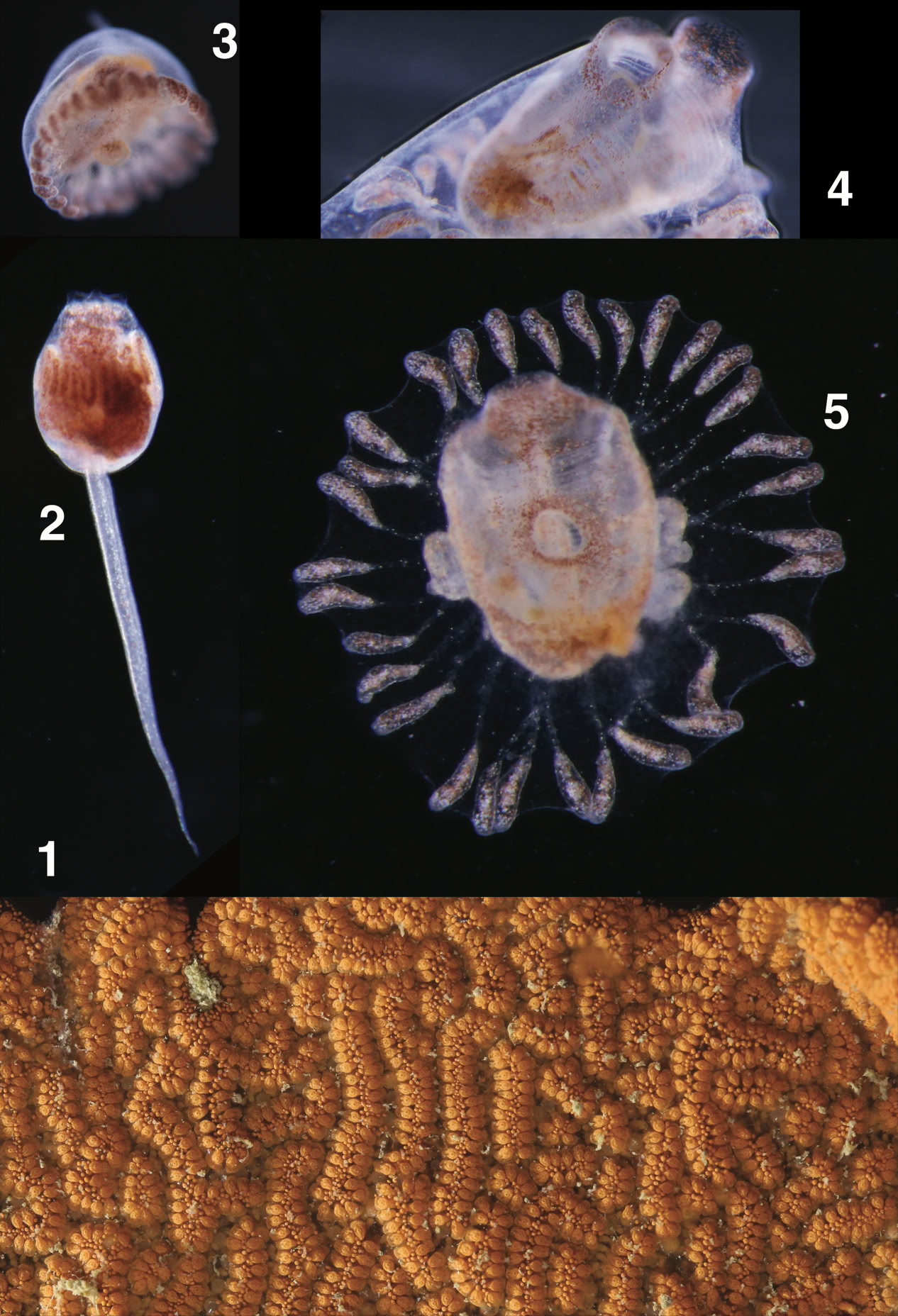

1. Colony: This is what you see on the dock,
an orange or yellow pancake a few centimeters in diameter. Here the surface has been cleaned and it is lit from the side so you see the individuals, called zooids, that form rows on the surface; there are several hundred in this field.
2. Tadpole: Special cells in the colony produce eggs that are fertilized by sperm from other colonies. The egg develops into the larva seen here, which has a head about a mm in diameter and a 3 mm long tail containing a notochord. It swims in random directions in the ocean for 1-2 days.
3. Ready to attach: About 30 ampulla now form a ring around the front of the tadpole.
4. Side view after attachment: The tadpole has metamorphosed into a zooid and is now pumping water through its body and catching small organisms in a sticky net which it eats.
5. Top view after attachment: You can see down into the hollow body through the top siphon (opening in the body). The ring of hollow ampulla around the body are full of blood and are connected to each other and the body by a network of vessels barely visible here. Ampullae contract about once every 90 minutes as they pump blood.
My studies on contractions of ampullae
Ampullae attached to a zooid sometimes contract in synchrony for several cycles and then contract independently for several cycles, with no fixed pattern in switching between the two modes. This type of behavior is called chaotic; not predictable.
If a group of ampullae are cut away from the zoid, the ends of the vessels heal within minutes and the ampullae continue to beat at about the same frequency. So the basic contraction machinery must be the cells themselves, they are not dependent on the zooid body.
If you cut out a pair of ampullae, they beat in a very regular way at a constant frequency and exactly 180 degrees out of phase. Thus, a small group of cells can beat beat in synchrony.
If you cut out a single ampullae it continues to beat at the same frequency but in a very different mode. The wall moves in a peristaltic fashion while keeping the volume of the ampullae constant, since a fluid is essentially incommpressible.
Coupled oscillators are important
More on ampullae contractions-
2016, Entrainment of Chaotic Oscillations in a Colonial Tunicate. Konrad, Michael W:
www.researchsquare.com/article/rs-655370/v2
https://youtu.be/S4KGR-7y4L8?si=kmWIiv0aa6WHW2fl
https://youtu.be/T58lGKREubo?si=RKZGrOtmvbtPZ3q4
Kuramoto talks about his work:
Coupled oscillators are all around us. The many generators that feed our electricity grid are all coupled so that their outputs are in phase. The muscle cells in our hearts will beat by themselves but are coupled to beat in phase to pump blood efficiently. The basic mathematics of coupled oscillators was developed in 1975 by Kuramoto (see above), who was advised then by his seniors not to waste his time on such trivia. Today there are large symposia on just this topic.