One mussel and its roommates
This section might be called science, but then it might be called art too: science is art!
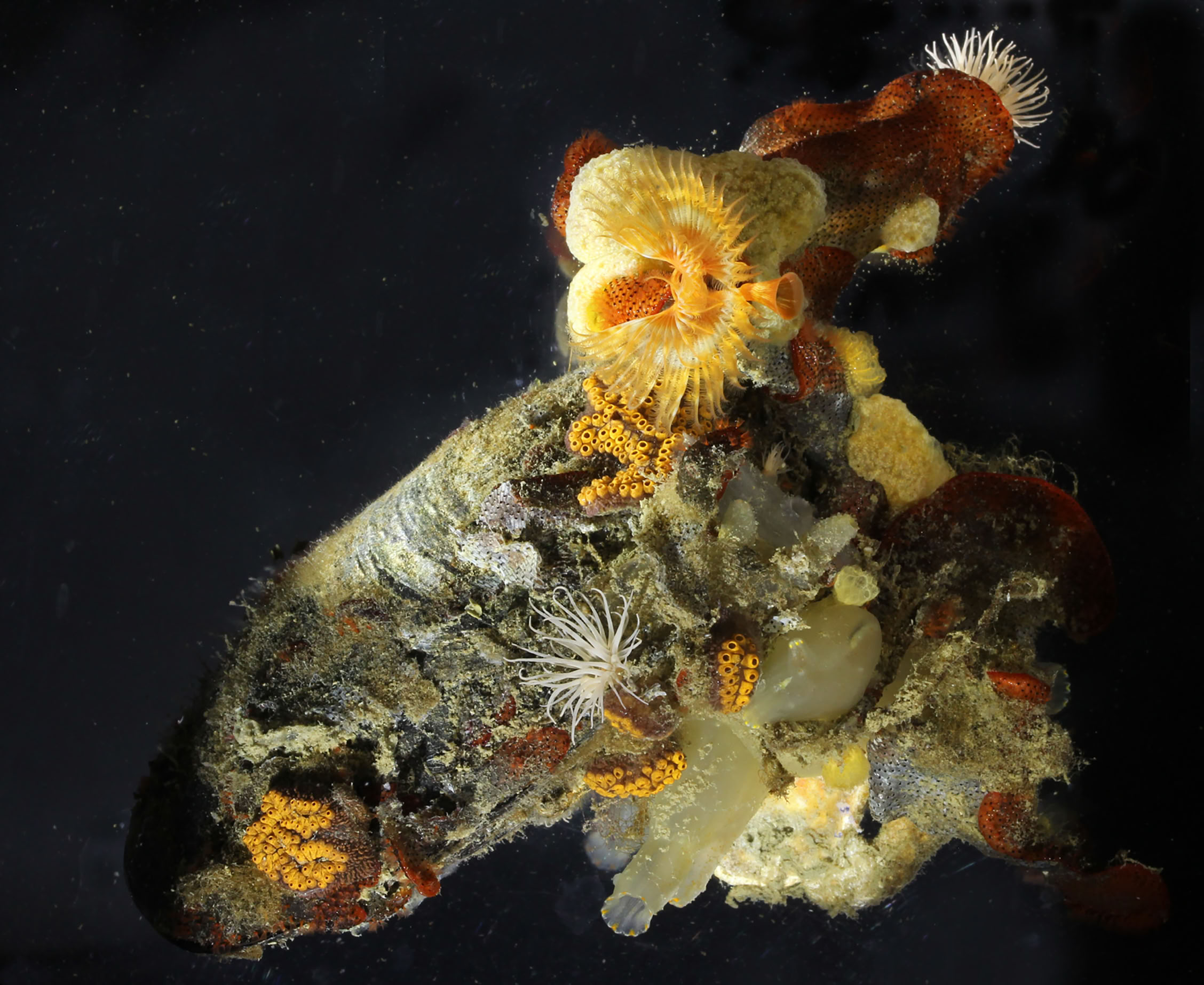
Humans have evolved to notice animals about their size because those are ones that might be good to eat or might want to eat them. However, the greatest number, mass and diversity of animals are much smaller than humans. Space can be at a premium in desirable locations, like the edge of a floating dock, and then animals become very crowed, often living on top of one another. This mussel, about 10 cm long, is an example, with a whole zoo living on it. At this magnification you can identify more than ten species, and at a higher magnification you could see many more.
At the upper right you see the crown of white arms of a sea anemone. A dark red-brown bryozoan hides the body of the anemone. Bryozoans are colonies of hydra living in a hard shell with small openings for each animal. The hydra have a relatively short life, so you see many Bryozoan shells that are empty.
Below the Bryozoan is a light yellow colonial tunicate (species?).
Growing through the tunicate colony is a tube worm. The tube extends downward and wraps around the back of the muscle, so is not visible. The yellow flower-like fan serves as a gill and also as a feeding net, since small prey are trapped and transported to the intestine of the animal. The orange cone extending to the right is the protective operculum, which will be pulled in last when the gills are retracted.
The rows of light orange cylinders below the worm are a tunicate colony. The grey-white tunicates at the bottom of the muscle are Ciona.
_________________________________________________________________________________
Heartbeat Rothko
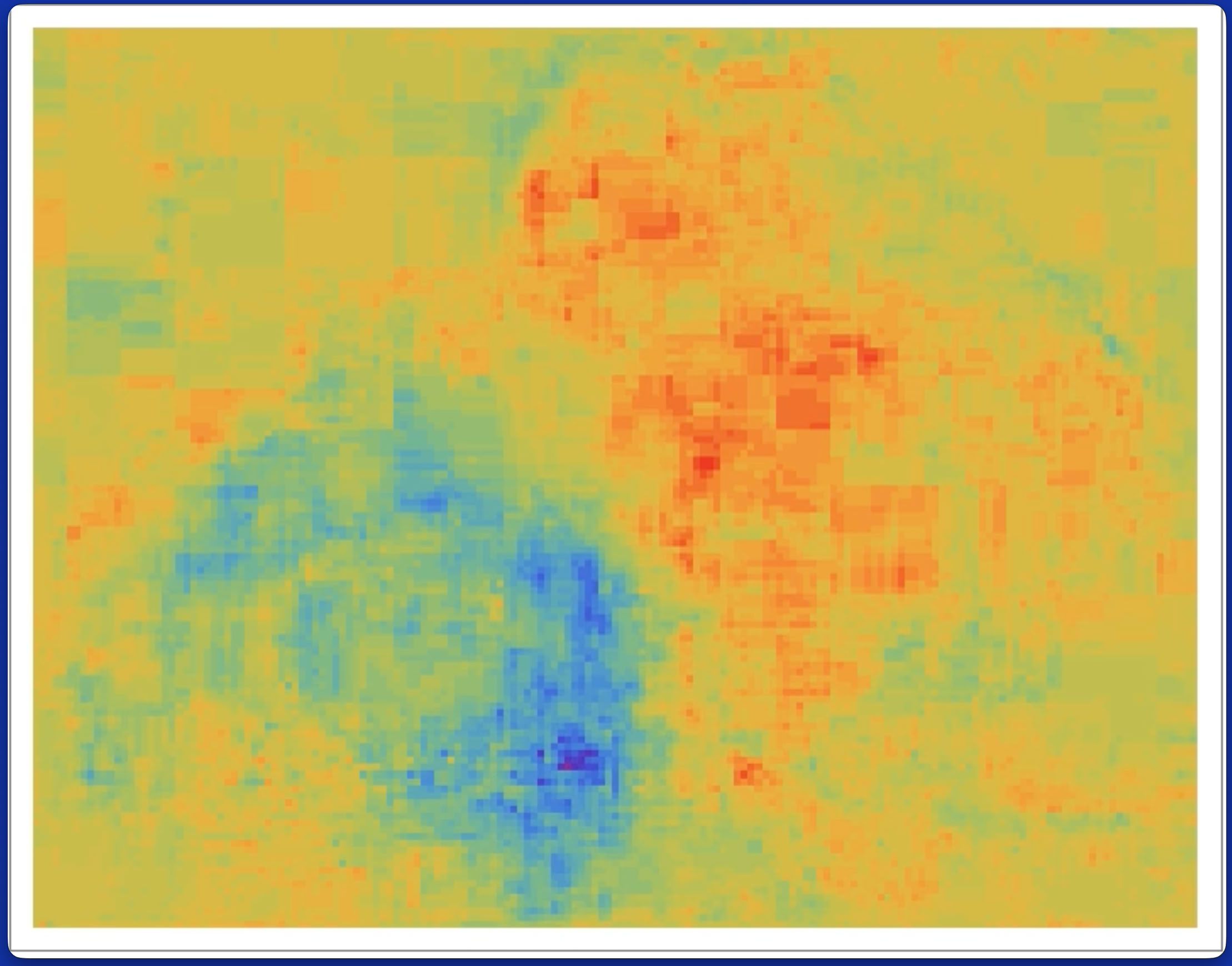
Two frames of a video of a Zebrafish heart were subtracted and grey levels encoded as colors. Subtraction reveals changes over time between frames, here 1/15 th of a second. The lower left blue zone is the ventricle and the upper right red zone is the ventricle. The actual field of view is about 0.6 by 0.4 mm.
_______________________________________________________________
Life under the dock
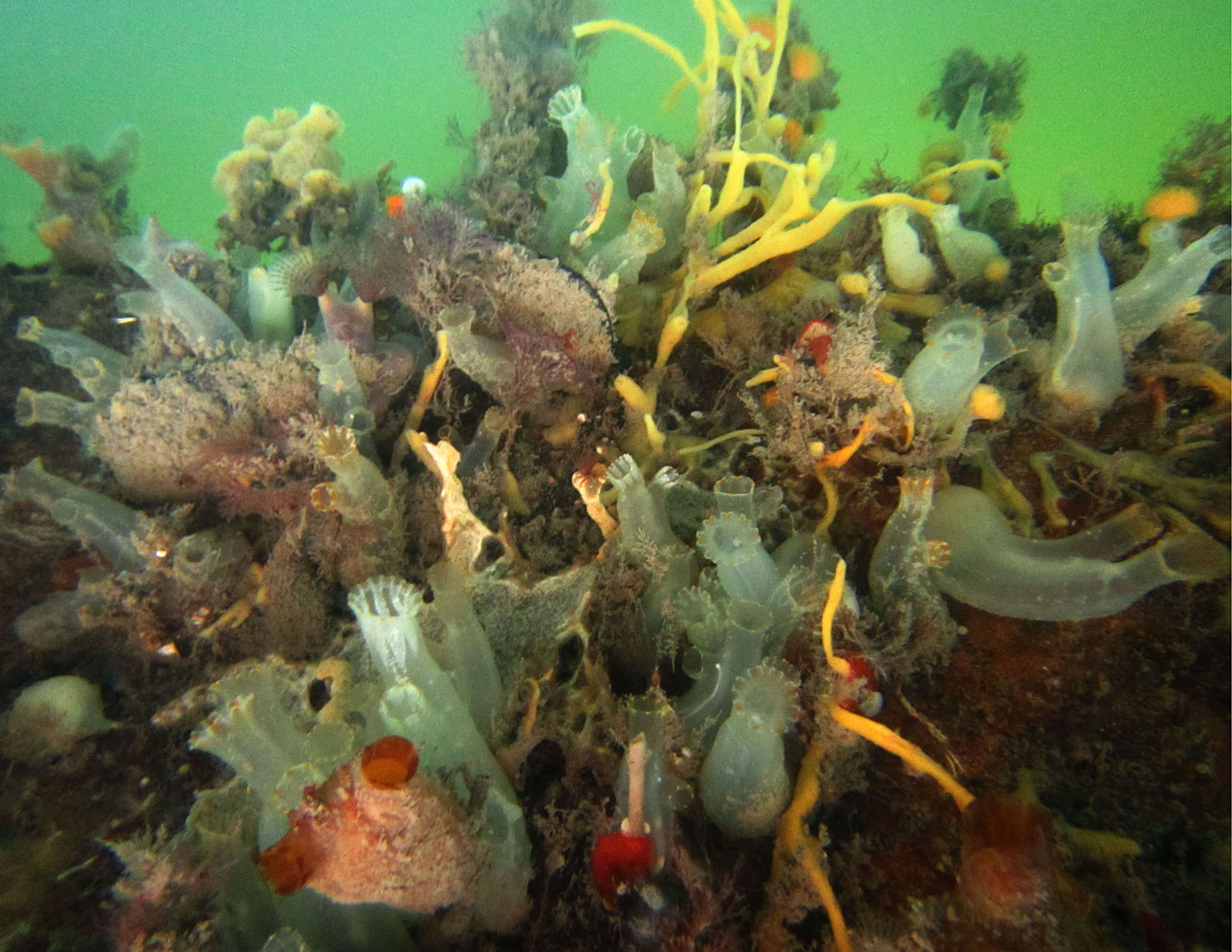
Life under a floating dock in Sausalito is a rich mix of species, just like the surface of the mussel. The image field of view is about 60 x 40 cm, and was obtained underwater using a GoPro camera. The yellow string-like animals are sponges. The translucent white vase-like animals are Ciona tunicates which feed by drawing in water through the “spouts”, siphons, and filtering out small organisms. There are tufts of algae in the background and another tunicate species with a brown siphon in the foreground, left of center.
______________________________________________________________________
A Large Botrylloides tunicate
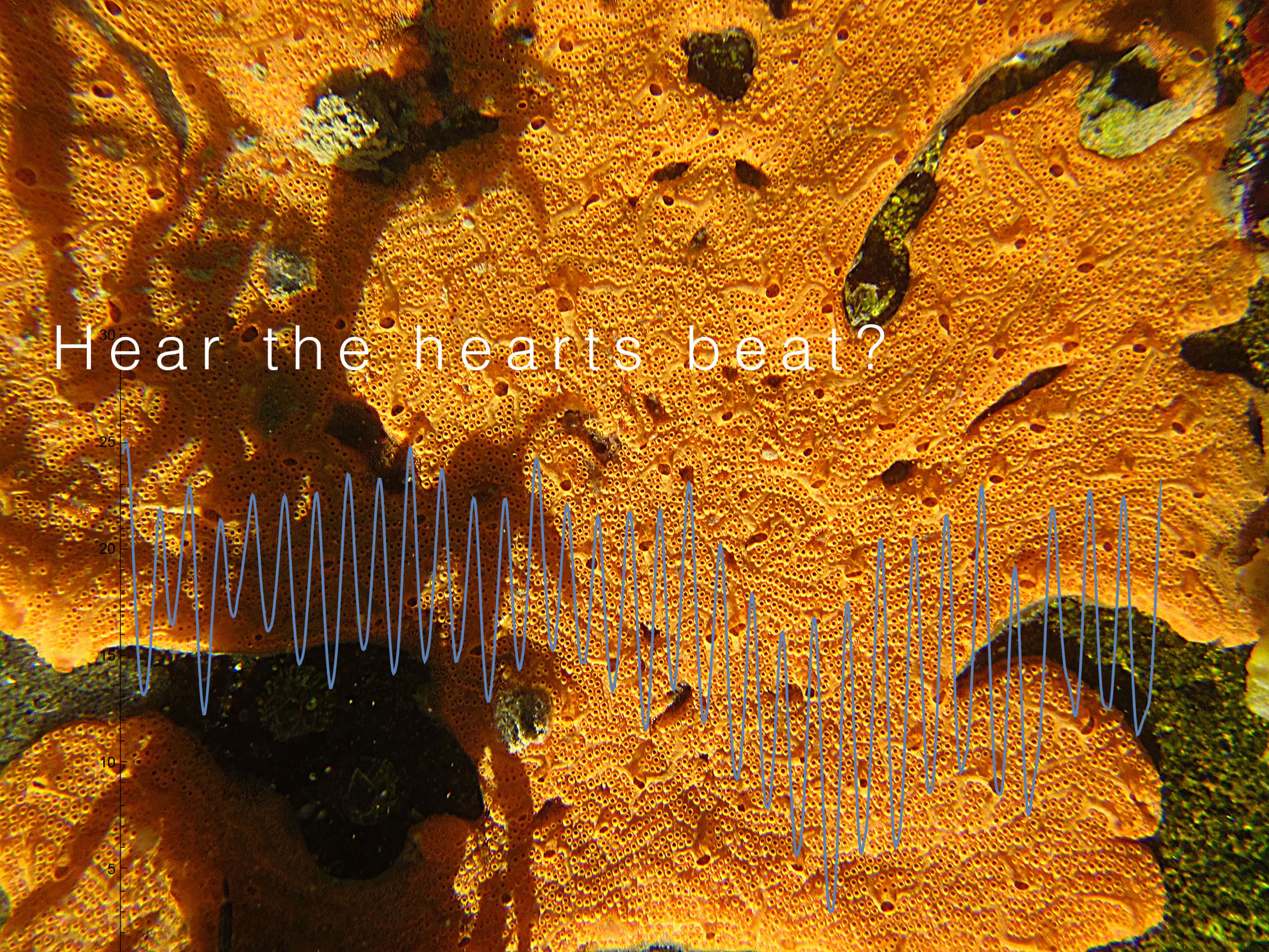
This is an unusually large colony, about 20 cm across. Like all tunicate colonies it started with one tadpole attaching to the rock and producing 3-4 more by budding, no sex involved. The several hundred individuals in this colony, zooids, are thus clones of the founder; everyone has the same DNA sequence. In this photo the zooids look like rows of small beads, 3 - 5 mm in diameter, with small black holes in the middle. The black holes are openings, siphons, through which the zooids draw water to feed by filtering. Each zooid has a heart, and the blue-gray wave is a real heart beat of one zooid heart obtained by analyzing a video taken with a microscope.