Complimentarity
This open, empty mussel shell consists of two complimentary chambers, or valves. They are complementary because they fit together tightly to protect the mussel. A DNA molecule consists of two complimentary nucleotide strands that fit together. The strands are complimentary because the nucleotides, attached to two long parallel strands of phosphodiesters, fit together fit together tightly to form pairs, held by hydrogen bonds. Here we see a guanine, yellow, bonded to cytosine, red, by three hydrogen bonds, the blue dots. This complementarity is more important than the fact that the two phospodidiester strands are twisted together to form a helix. Complimentarity is the basis for replication of DNA, the molecular incarnation of life.
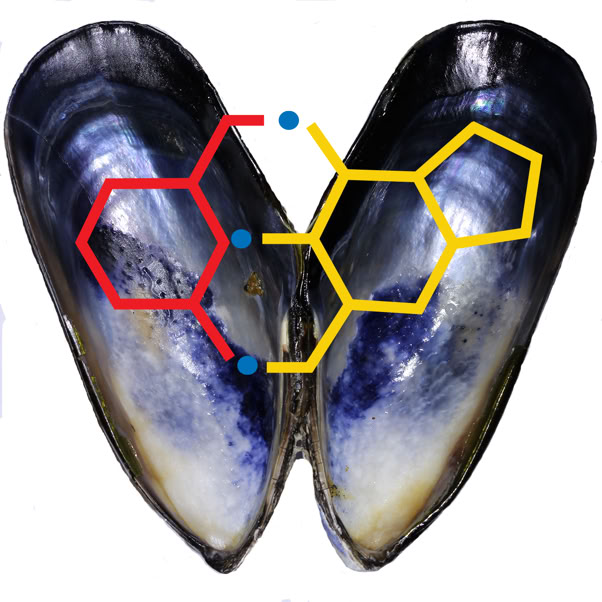
DNA mussel
site icon